MAGAZINIX Analysis
The Streaming Paradox.
Why Finding Something to Watch Has Become Entertainment's Biggest Challenge.
By Dr. Haina — on abundance, discovery, and the invisible layer that will define the next chapter of entertainment.
Author
Dr. Haina
Category
Analysis
Published
21 July 2026
Chapter
Entertainment
Reading time
10 min
Prologue
From Scarcity to Abundance
There was a time when finding something to watch was remarkably simple.
The television schedule decided for us. A trip to the local video store meant choosing from a limited collection of films that happened to be available. Even in the early years of streaming, the number of options felt manageable enough for discovery to remain almost effortless.
Today, the situation has fundamentally changed.
We have entered an era of unprecedented abundance. Hundreds of streaming services compete for our attention, collectively offering millions of hours of entertainment across every imaginable genre, language, and format. At first glance, this appears to be the ultimate achievement of the digital age. Never before has so much creative work been accessible to so many people, at virtually any time and from almost anywhere in the world.
Yet beneath this extraordinary success lies a paradox that has quietly become one of the industry's greatest challenges.
The problem is no longer access to content.
The problem is finding the right content.
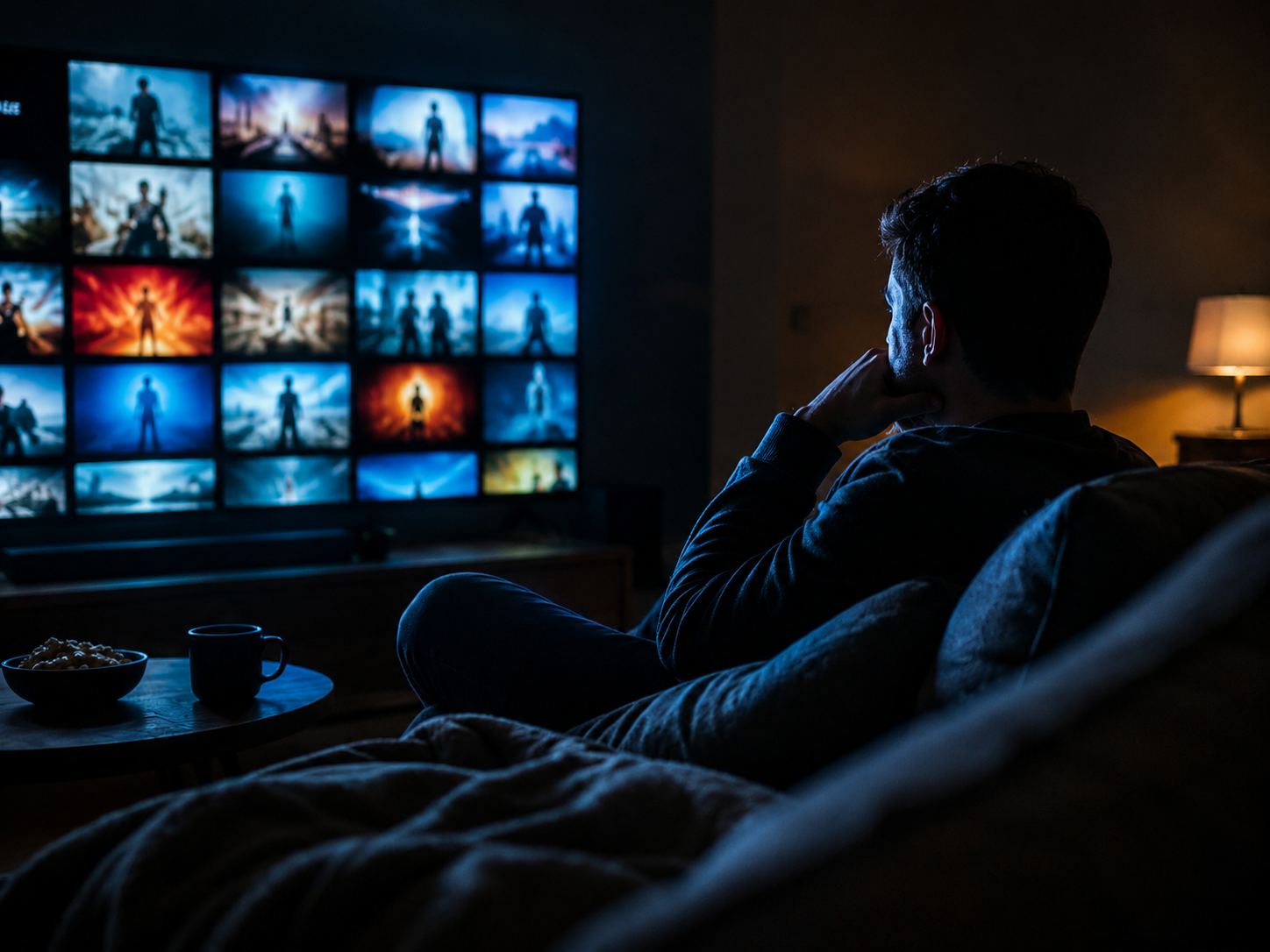
For millions of viewers, the evening no longer begins with watching a film. It begins with searching for one. Minutes turn into quarter-hours as viewers move from one recommendation to another, open multiple streaming applications, compare trailers, read reviews, and often end the evening watching something they never intended to watch — or nothing at all.
What appears to be a small inconvenience is, in reality, one of the most important strategic questions facing the future of entertainment.
"Discovery has become the new battleground."
Chapter I
The Cost of Abundance
The streaming industry has spent the past decade competing through scale. Every major platform has invested billions of dollars into expanding its catalogue, producing exclusive originals, acquiring prestigious studios, and licensing globally recognized franchises. The underlying assumption seemed obvious: the more content available, the greater the value for subscribers.
From a business perspective, that strategy made perfect sense.
From a psychological perspective, however, the picture is considerably more complex.
Human beings have never been required to process this level of abundance before. Our decision-making processes evolved in environments defined by scarcity, where choosing between a handful of alternatives was entirely sufficient. Modern streaming platforms present an entirely different cognitive landscape. Instead of selecting between five films, we are frequently confronted with thousands, many of which appear equally appealing.
Behavioral scientists have studied this phenomenon for decades. Research into what is commonly referred to as choice overload suggests that beyond a certain point, additional options do not necessarily improve decision-making. On the contrary, they often increase hesitation, reduce satisfaction, and create what psychologists describe as decision fatigue. More choice, surprisingly, does not always translate into greater freedom. Sometimes it simply creates more uncertainty.
Streaming illustrates this phenomenon almost perfectly. The challenge is no longer convincing audiences that there is enough to watch. The challenge is helping them decide.
Chapter II
Discovery as Product
This distinction changes the way we should think about entertainment.
For years, streaming platforms viewed themselves primarily as content businesses. Their competitive advantage was measured in productions, licensing agreements, subscriber growth, and viewing hours. Those metrics remain important, but they no longer tell the entire story.
An equally important question has emerged.
How efficiently can viewers move from opening an application to genuinely engaging with a story?
Every unnecessary minute spent searching represents friction. Every abandoned viewing session represents a missed opportunity — not only for the platform, but also for the creators whose work remains undiscovered despite existing within an enormous catalogue.
Discovery is therefore no longer a secondary feature of streaming. It has become part of the product itself. The search experience increasingly shapes the entertainment experience.
"Recommendation is not the same as understanding."
Chapter III
The Limits of Recommendation
Perhaps this explains why recommendation systems have become some of the most sophisticated forms of artificial intelligence currently operating at scale.
Every interaction contributes to an evolving profile. Viewing history, completion rates, genres, actors, languages, devices, viewing times, pauses, rewinds, abandoned titles, and countless additional behavioral signals are analyzed to predict what someone might enjoy next.
Technically, these systems are remarkable.
They process enormous volumes of data with extraordinary speed and precision, identifying patterns that would be impossible for any individual to recognize manually.
And yet, despite all this intelligence, a curious problem remains.
People still keep scrolling.
If recommendation algorithms have become so advanced, why do millions of viewers continue struggling to find something they genuinely want to watch?
The answer, I believe, lies in a subtle but fundamental distinction. Algorithms recognize patterns exceptionally well. Human beings live within context.
A recommendation engine may know that you watched three political thrillers during the past month. It may correctly assume that another political thriller deserves your attention. What it cannot fully understand is why you watched those films.
Perhaps you were researching a topic. Perhaps you had just finished reading a biography. Perhaps you simply wanted to disconnect after an exhausting week. Or perhaps tonight you are looking for something entirely different. Not because your taste has changed. But because your emotional state has.
Chapter IV
What People Are Really Searching For
People rarely search for content alone. More often, they search for an experience.
Some evenings we look for comfort. Other evenings we seek excitement. Sometimes we need inspiration. Sometimes distraction. Sometimes we simply want to laugh.
The title itself is often secondary. The feeling is not.
Understanding that distinction may well define the next chapter of the streaming industry. Because the future of discovery will not belong to the platforms with the largest libraries alone. It will belong to those capable of understanding not only what people watch — but why they are watching in the first place.
Traditional recommendation systems were built on a relatively straightforward assumption: past behavior is the strongest predictor of future behavior. If someone watched a particular genre, similar genres should follow. If viewers who enjoyed one film also watched another, the same recommendation can be extended to millions of others with comparable viewing patterns.
This approach has proven remarkably effective. Without these systems, modern streaming services would likely become unusable. However, effectiveness should not be mistaken for completeness.
Human preferences are far less static than viewing histories suggest. Unlike books on a shelf or songs inside a playlist, our emotional needs change continuously. They are shaped by circumstances that algorithms cannot easily observe: a stressful week at work, a family gathering, the changing seasons, a conversation that lingers in our minds, or simply the desire to experience something unexpected.
Context is fluid. Behavioral history is static. The distance between those two realities explains why viewers frequently ignore recommendations that appear perfectly logical on paper. A recommendation can be statistically accurate while remaining emotionally irrelevant.
Chapter V
From Prediction to Interpretation
For decades, data has been the primary currency of digital platforms. The prevailing assumption was simple: collect enough information, identify enough behavioral patterns, and increasingly accurate predictions will emerge.
Yet prediction alone has limitations.
Knowing what happened yesterday does not necessarily explain what matters today.
Artificial intelligence is gradually entering a new phase — one that places greater emphasis on context, intent, and human interaction. Rather than simply asking, what did this person watch before, future systems may begin asking entirely different questions.
What kind of experience is this person looking for right now? How much time do they have? Are they watching alone or together with family? Do they want to concentrate, relax, learn, escape, or simply be entertained?
These questions cannot always be answered through viewing history alone. They require a broader understanding of human behavior — one that combines data with context instead of treating them as separate domains.
Across almost every digital industry, users are becoming less interested in navigating information and more interested in receiving meaningful guidance through it. The abundance of information is no longer the problem. Navigation has become the challenge.
Chapter VI
An Ecosystem Challenge
For decades, the industry has largely been organized around ownership. Studios produce films. Streaming platforms license or acquire them. Audiences subscribe to individual services in exchange for access to carefully curated libraries. Each platform competes to keep viewers within its own ecosystem for as long as possible.
From a commercial perspective, this model has been enormously successful.
From a consumer's perspective, however, it has introduced a new form of fragmentation. A single household may subscribe to several streaming services simultaneously, each with its own interface, recommendation logic, search functionality, and exclusive catalogue. The challenge is no longer deciding what to watch. Increasingly, it is deciding where to begin looking.
Ironically, technology solved the problem of physical distribution only to create a new challenge in digital navigation. The abundance of platforms has become another dimension of the discovery problem.
The next stage of innovation may not necessarily emerge from producing more content or launching another streaming service. Instead, it may arise from technologies that operate above individual platforms, helping audiences navigate an increasingly fragmented entertainment landscape with greater clarity and confidence.
As digital ecosystems mature, they tend to develop new layers of intelligence that simplify complexity rather than expand it. Search engines organized the web. Operating systems organized software. Navigation systems organized transportation. Entertainment is approaching a similar inflection point.
One example is Flinix, which explores discovery as an independent layer of the entertainment ecosystem. Instead of asking viewers to choose between platforms, it asks a different question: how can technology simplify the journey to the right story, regardless of where that story is available?
Whether this specific approach becomes the prevailing model remains to be seen. Innovation rarely follows a single path. Yet the underlying question it addresses is unlikely to disappear. As streaming libraries continue to expand, intelligent discovery will become increasingly indispensable.
Epilogue
The Right Story
Perhaps that is the true streaming paradox. For years, the industry focused on creating unlimited access. Today, its greatest opportunity lies in creating meaningful direction.
The future of entertainment will not be defined solely by how many stories are produced, licensed, or streamed. It will also be shaped by how effectively those stories find the people they were meant to reach.
In the end, technology should not make decisions on our behalf. Its purpose is to remove unnecessary complexity so that human decisions become easier, more confident, and ultimately more meaningful.
The most valuable streaming experience may therefore begin long before the opening scene. It begins the moment someone stops searching… and starts watching.
In entertainment, what matters has never been the algorithm. It has always been the story. The future of streaming will not be defined by those who simply offer more content. It will be shaped by those who make meaningful discovery possible.
"We were never searching for more choices. We were searching for the right story."
Signed
Dr. Haina